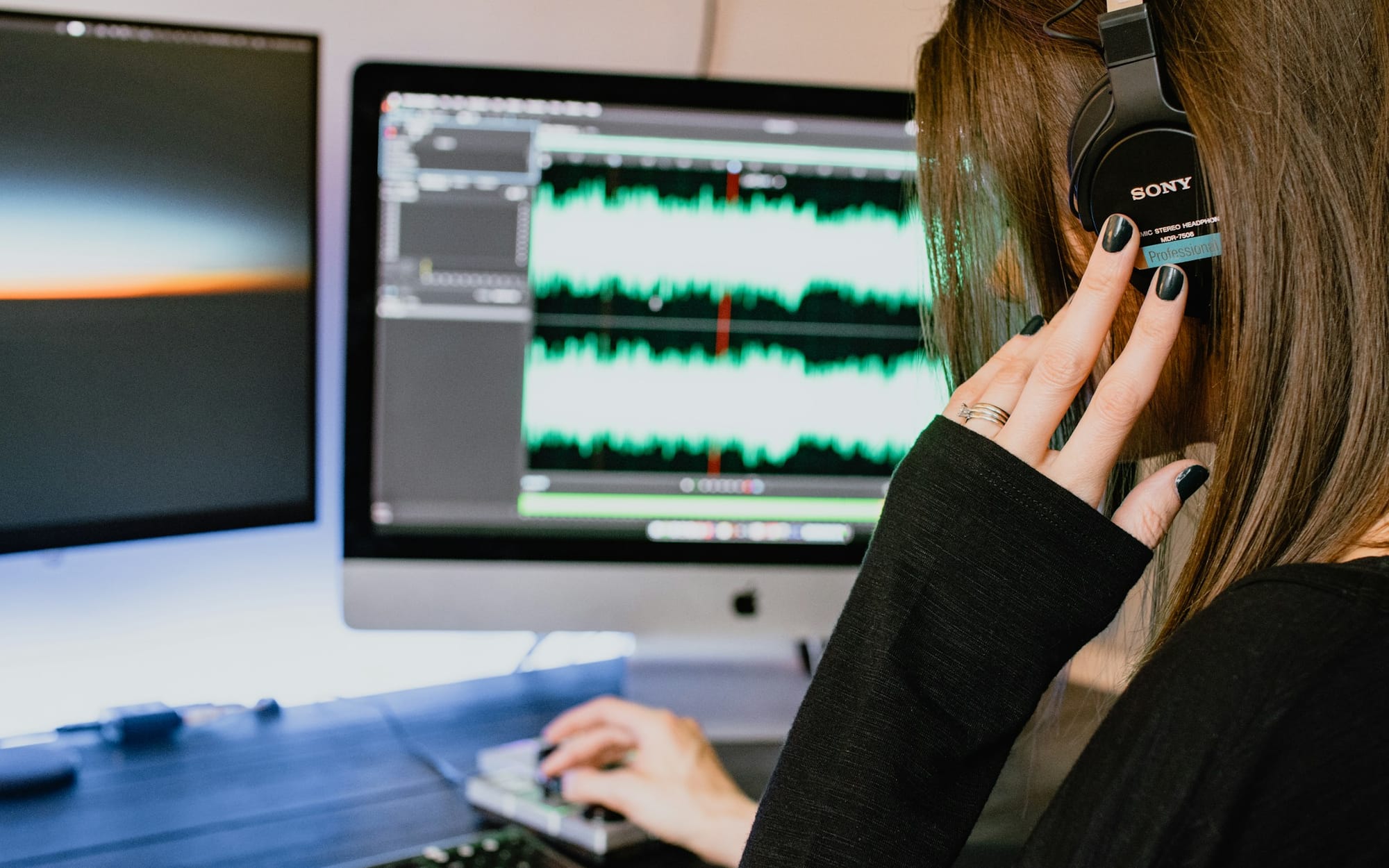
Verbatim transcription, ready for the record.
Audio and video transcription handled by linguists who understand that an evidentiary record cannot tolerate paraphrasing. AMS transcribes deposition recordings, witness statements, courtroom proceedings, interviews, and investigative audio with verbatim accuracy, speaker identification, and time-coded delivery on request.
Most quote requests are answered within 10 minutes.
What we transcribe
Deposition and trial recordings
Audio and video from depositions, evidentiary hearings, and courtroom proceedings transcribed verbatim with speaker IDs.
Witness statements and interviews
Recorded interviews, EUOs, and witness statements transcribed for case preparation and discovery.
Investigative audio
Surveillance recordings, recorded calls, and interview audio handled with strict chain-of-custody attention.
Foreign-language source recordings
Audio in a non-English language transcribed in the source language, translated into English, or both as a side-by-side deliverable.
Meetings, conferences, and interviews
Corporate meetings, panel discussions, and editorial interviews transcribed for internal use or publication.
Time-coded transcripts
Time-coded deliverables when the record needs to map back to specific moments in the recording.
Built for evidentiary use
Verbatim accuracy
Pauses, false starts, and cross-talk captured when fidelity to the record matters.
Speaker identification
Speakers labeled consistently throughout. Multi-party recordings handled with attention to who said what.
Rush turnarounds available
Standard, expedited, and rush turnaround windows. Short-notice requests handled with confirmation up front.
Audio transcription questions, answered
What audio formats does AMS accept?
AMS accepts MP3, WAV, M4A, AAC, OGG, FLAC, MP4 video, MOV, AVI, and most other common audio and video formats. Source quality matters more than format: clean audio with separated speakers transcribes faster and more accurately than muffled or overlapping speech.
Can AMS transcribe non-English audio and provide an English transcript?
Yes. AMS provides multilingual transcription with English target translation. We can also deliver bilingual transcripts (source language and English side by side) for evidentiary use.
What is a "verbatim" transcript vs. a "clean" transcript?
A verbatim transcript captures every utterance including pauses, false starts, filler words ("um," "you know"), and cross-talk. It is the appropriate format for legal evidentiary use. A clean transcript removes filler words and normalizes grammar for readability, appropriate for content production but not for the record.
How long does transcription take?
Standard turnaround is approximately 24 to 48 hours per hour of audio for English transcription, longer for multilingual transcription with translation. Same-day and rush turnaround is available for an additional fee. For long-form recordings, we discuss the timeline at quote time.
Is AMS audio transcription suitable for court use?
Yes. AMS produces verbatim transcripts with speaker identification, time stamps, and a signed Certificate of Accuracy. These are suitable for use as exhibits, deposition follow-ups, and other evidentiary purposes. For court-reporter-stamped transcripts of live proceedings, you need a certified court reporter; AMS supplies the linguistic transcription work that complements that.
Can AMS transcribe surveillance audio or recorded statements?
Yes. Surveillance recordings, recorded statements, jailhouse calls, and other low-quality audio are routinely handled. We can also perform forensic-level analysis where speaker identification and disputed-word adjudication are required.
Further reading
Foreign-language audio evidence: transcript and translation
What a defensible bilingual transcript exhibit contains, and the four failure modes to watch for.
Read the articlePreparing a non-English-speaking witness for deposition
Best practices for depositions involving interpretation; transcription often follows the deposition itself.
Read the articleCertified vs. notarized translation: what each one actually means
Useful context for transcripts that include translated source-language content.
Read the articleChoosing a language services provider for a law firm
The criteria that separate professional language services providers from order-takers.
Read the articleCourt interpreter ethics: the four canons
Useful context for transcribed proceedings that involved interpretation.
Read the articleIndigenous Mesoamerican languages in U.S. courts
When a recording contains indigenous-language audio, the transcription path differs from standard Spanish.
Read the articleAudio transcription services by metro
Multi-language transcription with local media pickup available in these metros.
Schedule with AMS
Request a quote or reach our scheduling team. AMS will assign the right linguist for your matter.
Most quote requests are answered within 10 minutes.